
Why Force-on-Force Training Fails More Often Than Agencies Realize
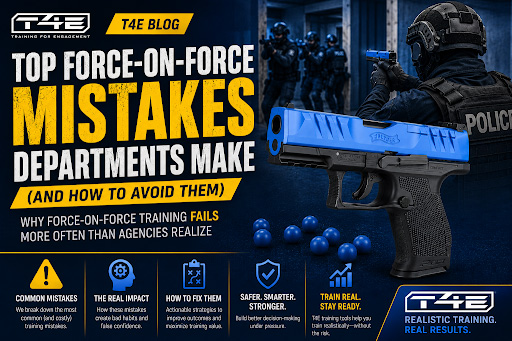 Force-on-force training has become one of the most effective methods for preparing law enforcement officers, corrections personnel, and tactical teams for real-world encounters. Unlike static range training or classroom instruction, force-on-force exercises place officers in dynamic, high-stress scenarios that test decision-making, communication, tactics, and judgment under pressure.
Yet many agencies fail to achieve the full benefits of force-on-force training because of avoidable mistakes in planning, execution, and evaluation.
Departments wanting to improve scenario realism can also review our article on How to Build CQB Training on a Budget and how realistic training environments improve decision-making under stress.
The goal isn't simply winning a scenario—it's improving critical thinking, tactical decision-making, communication, threat assessment, and legal use-of-force judgment.
Mistake #1: Focusing Only on Shooting Scenarios
One of the biggest mistakes departments make is designing every force-on-force exercise around lethal-force encounters.
In reality, officers spend far more time dealing with:
- Domestic disputes
- Mental health crises
- Traffic stops
- Suspicious persons
- De-escalation situations
- Crowd interactions
- Verbal conflict resolution
Modern force-on-force programs should include de-escalation, communication, and judgment-based encounters rather than focusing exclusively on lethal-force engagements.
De-Escalation and Scenario-Based Training
Improved Approach
Build scenarios that require officers to:
- De-escalate situations
- Gather information
- Communicate effectively
- Make restraint-based decisions
Many of the most valuable lessons occur when officers avoid using force altogether.
Mistake #2: Making Scenarios Predictable
Officers quickly recognize patterns.
If trainees know every scenario contains a threat, every suspect becomes a threat. If every role player eventually attacks, officers stop evaluating and start anticipating.
Predictable scenarios create artificial training scars that can negatively affect real-world performance.
Improved Approach
Include a mix of:
- Threat scenarios
- Non-threat scenarios
- Ambiguous encounters
- Cooperative subjects
- Witness interactions
- False alarms
The uncertainty is what creates realistic decision-making pressure.
Mistake #3: Ignoring Decision-Making and Focusing Only on Tactics
Many instructors evaluate movement, weapon handling, and officer safety but overlook the actual decisions being made.
A technically sound response can still be legally, ethically, or tactically wrong.
The true value of force-on-force training lies in testing judgment under stress.
Improved Approach
Measure:
- Threat recognition
- Communication quality
- Use-of-force justification
- Situational awareness
- Tactical patience
- Decision-making speed
Agencies should assess both actions and reasoning.
Mistake #4: Poor Role Player Preparation
Role players often determine whether a scenario succeeds or fails.
Untrained role players may:
- Overact
- Underact
- Deviate from objectives
- Escalate unrealistically
- Give obvious cues
When role players behave unnaturally, officers learn unrealistic responses.
Improved Approach
Provide structured role-player briefings that include:
- Character background
- Behavioral objectives
- Escalation triggers
- De-escalation opportunities
- Expected outcomes
Consistency creates better training data and more reliable evaluations.
Mistake #5: Failing to Replicate Realistic Stress
Force-on-force training is intended to bridge the gap between knowledge and performance under pressure.
Many departments unintentionally remove the stress component by:
- Allowing excessive preparation time
- Providing too much information beforehand
- Running overly scripted scenarios
- Creating unrealistic environments
Without stress, officers aren't truly testing their decision-making abilities.
Improved Approach
Introduce realistic stressors such as:
- Time pressure
- Environmental distractions
- Conflicting information
- Multiple subjects
- Unexpected developments
Stress should be challenging but controlled and safe. Effective stress-exposure training requires equipment and scenarios that closely mimic real-world encounters while maintaining safety.
T4E S&W M&P9 M2.0 Training Marker
Mistake #6: Neglecting Safety Protocols
The fastest way to damage a force-on-force program is through preventable safety failures.
Common issues include:
- Improper weapon checks
- Inadequate protective equipment
- Poor scenario control
- Lack of safety officers
- Insufficient participant briefings
Even minor safety incidents can undermine confidence in training programs.
Improved Approach
Establish a dedicated safety plan that includes:
- Multiple weapon inspections
- Designated safety officers
- Medical contingency plans
- Protective gear requirements
- Clear stop-training procedures
Safety must always remain the highest priority. Agencies should use purpose-built training tools designed specifically for force-on-force environments rather than improvised alternatives.
T4E Training Pistols Overview
Mistake #7: Conducting Weak Debriefs
The scenario itself is only half the training event.
Learning accelerates during the after-action review when participants reflect on decisions, mistakes, and successes.
Departments often rush through debriefs or focus only on what officers did wrong.
Improved Approach
Use structured debrief questions:
- What did you observe? What influenced your decisions? What alternatives were available? What worked well? What would you change?
Effective debriefs transform experiences into lasting lessons.
Mistake #8: Measuring Success by Scenario Outcomes
Some agencies evaluate success based on whether the officer "won" the scenario.
This creates a dangerous mindset.
In reality, an officer can make excellent decisions and still face difficult outcomes. Likewise, an officer may "win" while making poor tactical choices.
Improved Approach
Evaluate:
- Process quality
- Decision-making
- Policy compliance
- Tactical effectiveness
- Communication skills
- Threat assessment accuracy
Focus on performance indicators rather than outcomes alone.
Mistake #9: Running Force-on-Force Training Too Infrequently
Many departments conduct force-on-force exercises once per year and expect long-term performance improvements.
Skills deteriorate rapidly without repetition.
Research consistently shows that decision-making under stress improves through repeated exposure and deliberate practice.
Improved Approach
Implement force-on-force training throughout the year. Even short, low-resource scenarios can provide valuable repetitions and reinforce critical skills.
Consistency produces competence. Cost-effective training systems make it easier for agencies to increase repetitions and conduct force-on-force sessions throughout the year.
Train More. Spend Less. Training Solutions
Mistake #10: Failing to Align Training With Real Incidents
Some agencies build scenarios based on assumptions rather than actual field encounters.
As a result, officers train for events that rarely occur while neglecting common operational challenges.
Improved Approach
Use data from:
- Officer reports
- Body-worn camera reviews
- Internal investigations
- Use-of-force incidents
- Community complaints
- Near-miss events
Training should reflect the realities officers face in the field.
The Future of Effective Force-on-Force Training
Modern force-on-force programs are evolving beyond simple tactical exercises. The most successful agencies are using scenario-based training to develop decision-making, emotional control, communication, and judgment under stress.
Departments that avoid these common mistakes create training environments that are safer, more realistic, and more closely aligned with operational realities.
Key Takeaways
- Avoid making every scenario a shooting scenario.
- Build unpredictability into training events.
- Evaluate decision-making, not just tactics.
- Invest in role-player preparation.
- Create realistic but controlled stress.
- Prioritize safety at every stage.
- Conduct meaningful after-action reviews.
- Measure performance, not outcomes.
- Train consistently throughout the year.
- Base scenarios on real-world incidents.
When designed correctly, force-on-force training becomes one of the most valuable tools available for improving officer performance, reducing risk, and increasing public and officer safety.