
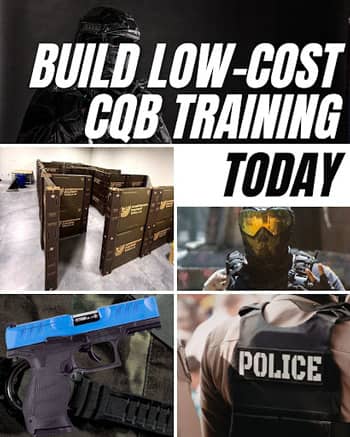
 Modern law enforcement encounters happen fast and often in confined spaces. Officers may be required to clear:
- Schools
- Apartments
- Office buildings
- Hotels
- Shopping Centers
- Houses
Static range training alone cannot fully prepare officers for these locations.
Reality-based CQB training allows officers and trainees to practice:
- Room clearing
- Team communication
- Threat identification
- Movement under stress
- Use-of-force decision-making
- Active shooter response
- De-escalation techniques
The more realistic the training environment, the more valuable the repetitions become.
The Challenge: Budget-Friendly Tactical Training
Many departments assume realistic CQB training requires:
- Permanent ballistic shoot houses
- Large facilities
- Expensive ammunition
- Extensive range infrastructure
- Full-time training staff
That often leads agencies to reduced training frequency or rely heavily on classroom instruction. But modular wall systems and force-on-force training platforms are changing that.
Building Affordable CQB Training with Training Markers and Modular Training Walls
One of the most effective ways to reduce CQB training costs is through high-quality, low-cost training markers and modular training environments.
Unlike traditional simunition rounds that have a higher cost per round and not a 1:1 ratio on training pistol vs issued duty pistols - T4E (Training for Engagement) levels up on both counts for a lower cost per round, and a 1:1 ratio to the firearm counterparts.
As for modular walls, unlike permanent structures, they can be adapted for multiple training objectives while reducing construction costs and facility limitations.
Using T4E Products for Reality-Based Training
To maximize realism while maintaining safety, many departments and agencies are integrating T4E force-on-force training products into their CQB programs.
T4E training markers allow officers to experience:
- Stress exposure
- Real-time decision-making
- Simulated suspect interaction
- Communication breakdowns
- Movement and reaction drills
without using live ammunition.
Recommended T4E Products for CQB Training
T4E Walther PDP Training Marker
The T4E Walther PDP training marker is ideal for agencies carrying optic-ready duty pistols. Its realistic feel and handling characteristics help officers build familiarity while training in scenario-based environments.
Best used for:
- Room clearing drills
- Officer movement training
- Force-on-force exercises
- Decision-making under stress
T4E Smith & Wesson M&P9 Training Marker
The T4E M&P9 training marker supports departments using the Smith & Wesson duty platform and allows instructors to replicate realistic patrol-based encounters safely.
Excellent for:
- Patrol response scenarios
- School safety drills
- Active shooter response
- Team communication exercises
Benefits of Modular CQB Training Walls
-
Lower Facility Costs
Agencies can convert existing warehouse space, garages, training rooms, or unused buildings into realistic CQB environments.
-
Scenario Flexibility
Layouts can change frequently to support:
- Active shooter response training
- Hostage rescue scenarios
- Patrol response drills
- Building search exercises
- School safety training
-
Increased Training Frequency
Because setups and take-downs are easier to operate, departments and agencies can run more frequent training sessions without major operational disruption.
Why Force-on-Force Training Improves Officer Readiness
One of the biggest weaknesses in traditional firearms qualification is the lack of realistic decision-making pressure.
Force-on-force training introduces:
- Stress
- Unpredictability
- Human interaction
- Movement
- Consequences for poor tactics
This type of reality-based training helps officers improve:
- Threat recognition
- Tactical communication
- Situational awareness
- Confidence under pressure
- Reaction time
Most importantly, it allows mistakes to happen in training instead of real-world incidents.
Building a Scalable CQB Program
Agencies do not need to build everything at once.
A scalable CQB training program can start with:
- Basic force-on-force training markers
- A modular wall setup
- A small training space
- Instructor-led scenarios
From there, departments can gradually expand training complexity and facility capabilities.
Low-Cost CQB Training Ideas
- Repurpose Existing Buildings
Unused facilities or warehouse spaces can become highly effective training environments.
- Rotate Scenarios Frequently
Changing room layouts and suspect roles prevents pattern recognition.
- Integrate Decision-Making Drills
Not every scenario should end with force. Include communication and de-escalation objectives.
- Train in Teams
Communication and movement coordination are critical during CQB operations.
- Use Video Review
Recording scenarios helps instructors evaluate tactics, communication, and officer performance.
More CQB Training for Less
By combining modular wall systems like American Range Walls with realistic T4E training platforms, agencies can build affordable, scalable CQB programs that improve officer readiness without overwhelming budgets.
Effective CQB training does not have to be expensive to be impactful.
Reality-based training builds confidence before the real call comes in — and affordable training solutions make that preparation more accessible than ever.