
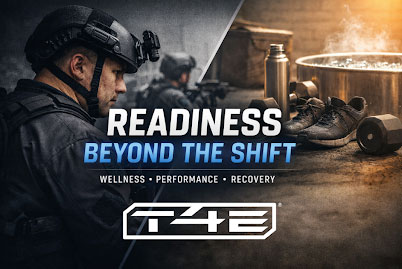
 For law enforcement officers and first responders, the job rarely ends when the shift clock hits zero. The physical strain, high-stakes decisions, and constant vigilance required on duty often follow responders home — affecting sleep, recovery, mental clarity, and overall wellbeing.
That’s why true readiness isn’t just about tactical skills or equipment. It’s about total wellness.
As we support Police1 in recognizing First Responder Wellness Week (March 23–27), focusing on how to better support the physical, mental, and cognitive health of those who protect our communities.
At Training for Engagement (T4E), we see firsthand how wellness directly impacts training performance, decision-making under stress, and long-term career sustainability.
Because the reality is simple: A healthier officer is a more prepared officer.
Training Performance Starts with Physical Readiness
Scenario-based training—especially force-on-force exercises—requires officers to operate under stress, fatigue, and rapidly evolving situations.
When officers are physically depleted or poorly recovered, it affects:
- Reaction time
- Decision-making speed
- Situational awareness
- Injury risk during training
- Learning retention from scenario outcomes
Wellness practices like nutrition, sleep, and recovery strategies are not separate from training—they are foundational to it.
When officers arrive at training prepared and physically recovered, they gain more value from each scenario and develop stronger performance habits that carry into the field.
The Brain Is a Tactical Tool
Modern law enforcement training increasingly focuses on cognitive performance under pressure.
High-stress scenarios demand:
- Rapid threat recognition
- Clear communication
- Emotional control
- Tactical decision-making in seconds
Research continues to show that nutrition, sleep quality, and stress management have a major impact on cognitive performance.
Poor sleep alone can significantly reduce:
- Focus
- Impulse control
- Judgment
- Memory retention
For officers who must make life-altering decisions in seconds, protecting brain health is just as important as firearms proficiency.
Recovery Is Not Weakness — It’s Operational Readiness
Many first responders have historically pushed through fatigue, soreness, and mental exhaustion. But the profession is evolving to recognize something important:
Recovery is part of performance.
Tools like:
- Ice baths and cold therapy
- Mobility and stretching
- Breathwork and stress reduction
- Proper hydration and nutrition
can dramatically improve both physical resilience and mental recovery.
Recovery practices help officers return to duty—and to training—more focused, less fatigued, and better prepared.
Scenario Training Benefits from a Healthy Mindset
T4E training equipment is designed to replicate the complexity of real-world encounters. These tools equip officers to exercise scenarios in situations that require:
- Split-second judgment
- De-escalation skills
- communication under pressure
- use-of-force decision making
When officers are mentally and physically well, they are more capable of:
- processing scenario feedback
- adapting their tactics
- improving performance during repetitions
Wellness doesn’t just help officers survive the job—it helps them learn from training and improve over time.
Supporting Overall Wellness
As the conversation around responder wellness grows, training organizations have an opportunity to support that mission.
By combining realistic scenario training with a culture that values wellness, we help ensure officers are prepared not only for today’s calls—but for the long road ahead.
Because at the end of the day, readiness is about more than tactics.
It’s about taking care of the people behind the badge.