
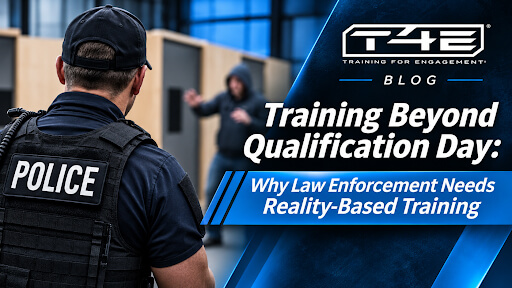
 Passing qualification proves proficiency on the range. Real-world encounters demand more.
For law enforcement officers, firearm qualifications are an essential part of maintaining readiness. It confirms an officer can meet established standards for firearm handling and accuracy.
But qualification day is only one piece of the training picture.
Real-world encounters don't happen on a predictable firing line. They involve movement, uncertainty, split-second decisions, verbal commands and constantly changing circumstances.
That's why reality-based training and force-on-force scenarios are essential components of a comprehensive law enforcement training program.
Qualification Is the Standard. Not the Finish Line.
Traditional police firearms qualification measures important technical skills. Officers must demonstrate safe firearm handling, accuracy and proficiency under established course requirements.
However, qualification courses cannot fully replicate the complexity of an active encounter.
In the field, officers must simultaneously evaluate threats, communicate, maintain situational awareness and determine whether force is justified.
An officer may perform well on the range but still need additional training to recognize a threat, respond appropriately and make decisions under pressure.
The goal isn't simply to qualify. It's to build the skills officers need when the situation isn't scripted.
What Is Reality-Based Training for Law Enforcement?
Reality-based training (RBT) uses controlled, realistic scenarios to help officers apply their skills in situations that reflect potential encounters on duty.
Unlike traditional range exercises, scenario-based police training can incorporate role players, environmental challenges and rapidly changing circumstances.
Officers must evaluate the entire situation rather than focus solely on a target.
Effective reality-based training can reinforce:
- Threat Recognition: Identifying potential threats while avoiding premature assumptions.
- Decision-Making: Determining when force is necessary and when alternative responses are appropriate.
- Communication: Using clear verbal commands and coordinating with other officers.
- Movement and Cover: Maintaining awareness of surroundings and available protection.
- De-Escalation: Recognizing opportunities to slow, stabilize or resolve an encounter without force.
- Firearm Handling: Applying trained skills in dynamic, controlled environments.
These exercises give instructors opportunities to evaluate not just what officers do, but how and why they make particular decisions.
Why Force-on-Force Training Matters
A paper target doesn't move unpredictably, communicate or change its behavior.
A role player can.
Force-on-force training introduces human interaction into controlled training exercises, allowing officers to experience scenarios that require observation, judgment and appropriate responses.
Consider a simulated patrol encounter. An officer approaches an individual who initially appears cooperative but begins behaving unpredictably.
Does the officer recognize changing circumstances? Maintain appropriate distance? Communicate effectively? Identify whether the individual presents an actual threat?
These are skills that cannot be measured by shooting accuracy alone.
Force-on-force exercises also create opportunities to identify performance gaps and address them through instructor-led feedback.
Building Better Training With T4E Training Markers
Realistic training requires equipment designed for your training environment.
T4E® Training for Engagement offers training markers that can be incorporated into structured force-on-force and scenario-based law enforcement exercises.
T4E training platforms allow instructors to develop interactive exercises involving role players, simulated encounters and changing conditions.
Training applications can include:
Patrol Response Scenarios: Practice threat assessment, communication and appropriate response during simulated calls for service.
Building Searches: Reinforce teamwork, situational awareness and movement through controlled training environments.
Close-Quarters Training: Evaluate decision-making, communication and firearm handling in confined spaces.
Shoot/No-Shoot Exercises: Challenge officers to assess threats and make legally and tactically appropriate decisions.
Optic-Ready Training: Incorporate pistol-mounted red-dot optic skills into dynamic exercises using compatible training platforms such as the T4E Walther PDP Optic-Ready Training Marker.
All training exercises should be conducted under established safety procedures with qualified instructors, appropriate protective equipment and dedicated training areas.
More Repetitions. More Opportunities to Improve.
One of the challenges facing law enforcement agencies is finding the time and resources to provide consistent, meaningful training.
Qualification may occur periodically, but decision-making and communication skills benefit from continued practice.
Incorporating reality-based exercises into an agency's training schedule creates opportunities to reinforce skills between qualification sessions.
Not every scenario needs to be elaborate. A focused exercise involving a routine patrol encounter, a changing threat assessment or a communication challenge can create valuable learning opportunities.
The key is consistent training, clear objectives and meaningful feedback.
After each scenario, instructors should evaluate what happened, identify areas for improvement and reinforce appropriate responses.
Training doesn't end when the scenario stops. The debrief is where much of the learning happens.
Frequently Asked Questions About Law Enforcement Reality-Based Training
What is the difference between firearms qualification and force-on-force training?
Firearms qualification evaluates an officer's ability to meet established firearm proficiency standards. Force-on-force training introduces interactive scenarios with role players, allowing instructors to assess decision-making, communication, threat recognition and firearm handling in dynamic situations.
Why is scenario-based training important for police officers?
Scenario-based training helps officers practice applying their skills in unpredictable situations. It creates opportunities to evaluate appropriate use-of-force decisions, communication, situational awareness and responses to changing circumstances.
How often should law enforcement agencies conduct reality-based training?
Training frequency depends on agency resources, policies and operational requirements. Incorporating shorter scenario-based exercises throughout the year can help reinforce skills between formal qualification sessions and also reduce liability.
Can T4E training markers be used for police force-on-force training?
Yes. T4E offers training markers designed for controlled training applications, including scenario-based and force-on-force exercises. Agencies should select equipment appropriate for their training objectives and follow all manufacturer instructions and established safety protocols.
Does reality-based training replace firearms qualification?
No. Reality-based training complements firearms qualification and live-fire instruction. Each serves a different purpose in developing and evaluating officer readiness.
Train Beyond the Minimum.
Meeting qualification standards is important. Preparing officers to respond appropriately in complex, unpredictable situations requires more.
By incorporating reality-based training, force-on-force exercises and consistent scenario-based instruction, law enforcement agencies can create additional opportunities to develop critical skills beyond the firing line.
T4E Training for Engagement supports that mission with training platforms designed for realistic, interactive training environments.
Qualification measures a standard. Training builds readiness.
Take Your Training Beyond Qualification Day
Explore T4E training markers and solutions designed for law enforcement force-on-force and reality-based training.
Explore T4E Training Solutions
Questions about incorporating T4E products into your agency's training program?
Contact Training@T4Eguns.com.